













More SMEs are measuring their carbon footprint and setting Net Zero targets as part of their sustainability strategy.
Small businesses are coming under increasing pressure on sustainability, with increasing customer expectations, stricter public tender requirements, rising energy prices and ESG requests from financiers and investors.
Measuring your scope 1, 2 and 3 emissions to create a baseline is the first step to achieve Net Zero, helping you to win more contracts, reduce your energy costs and access finance more easily.
Book a Free Sustainability Call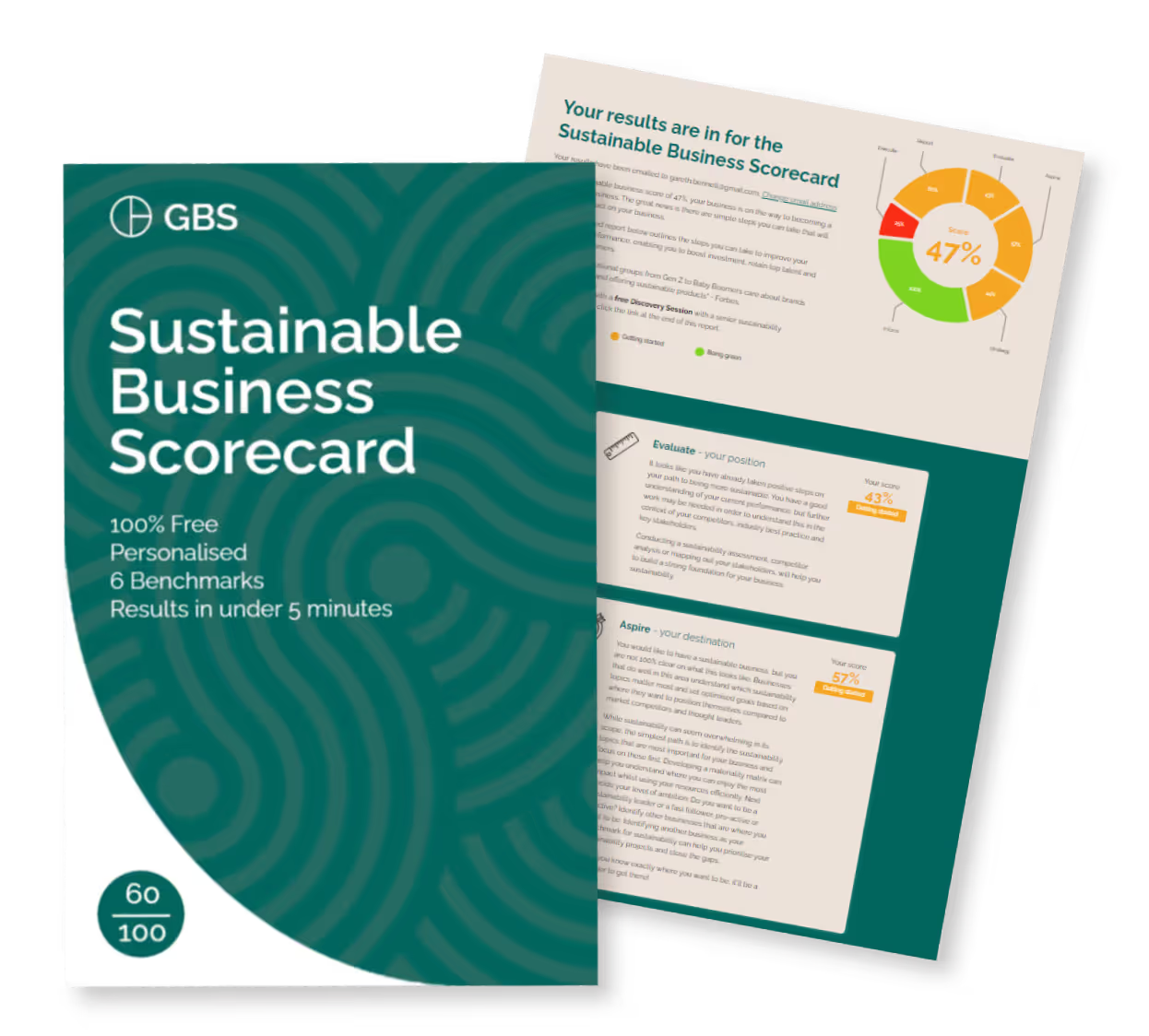
Our Sustainability Scorecard helps businesses quickly assess their current sustainability performance across key ESG topics.
In less than five minutes, you'll receive:

A sustainability rating
Practical recommendations
Identification of key strengths
A clearer sustainability roadmap
Areas for improvement

Instant results. No credit card required.
Carbon emissions of small businesses are categorised into three scopes: scope 1 (direct), scope 2 (indirect) and scope 3 (value chain) emissions.
Scope 1 (direct) emissions are those created by direct fuel use, such as by a natural gas boiler, a diesel car engine or refrigerants from a chiller unit.
Scope 2 (indirect) emissions are those from energy used by your business but where the generation happens at another business, such as grid electricity consumption.
Scope 3 (value chain) emissions include all other emissions that are created as a result of your business activity, including travel, purchases of products and services, waste, packaging, freight, leasing, and employee commuting, amongst others. Scope 3 emissions typically represent a large proportion of SME emissions.
Book a Free Sustainability Call

"We choose to work with Gareth again and again because he provides clear, professional and easy to understand solutions. We would strongly recommend him to any organisation looking to strengthen its sustainability strategy and create measurable impact."
Many small businesses choose to publicly report their carbon footprints as part of a Carbon Reduction Plan. You can link this as a standalone document to your website homepage to make this easy to find for your customers and procurement teams.
Having a Carbon Reduction Plan can help UK businesses with current public procurement requirements such as PPN 006 (formerly PPN 06/21) or the NHS Evergreen Assessment. Bidders on projects may be asked to provide a Net Zero Carbon Reduction Plan that covers scope 1, 2 and a subset of scope 3 (value chain) emissions.
Small businesses with a Net Zero Carbon Reduction Plan and that measure and report their scope 1, 2 and 3 carbon footprint are well-placed to meet their client and tender requirements.
Book a Free Sustainability CallNet Zero is where human-caused greenhouse gas (GHG) emissions are balanced by removing the same amount of emissions over a specified time period. For businesses this means reducing emissions by at least 90% by 2050 or earlier.
Use your carbon footprint to identify your largest sources of emissions and prioritise these in your roadmap. Consider breaking down your planned actions into three phases: short-term actions (0-12 months) for quick and cost effective 'quick wins'; medium-term actions (1-3 years) for larger projects and long-term actions (3-10 years) for those that require more structural change.
For more information on developing a Net Zero Roadmap, check out our Net Zero Guide for SMEs.
Book a Free Sustainability Call
This is ideal if:
If this sounds like you, then arrange for a free no commitment call with an adviser today.
Arrange a Free Sustainability CallAfter developing your Net Zero roadmap, it becomes easier to implement your carbon redution measures.
Prioritise quick wins to rapidly generate savings and create a positive cycle. This will help you to keep momentum when you want to invest in longer-term reductions.
We would always recommend carbon reduction measures ahead of carbon offsets. This can help your business, as carbon reduction measures often reduce operating costs, and will align you to the requirements of Net Zero and the Science Based Targets initiative (SBTi).
Book a Free Sustainability Call

As a local Christian organisation, Wombourne URC wanted to measure their carbon footprint as part of the ECO-Church award scheme. However, they had little experience in sustaniability and admitting to feeling a little overwhelmed by the technical requirements needed to calculate their carbon footprint. For this they approached GB Sustainability.
Within two weeks, GB Sustainability conducted a Scope 1 and 2 carbon footprint assessment, including accounting for the specific green energy tariffs used at the church premises. Using this as part of their application, Wombourne became the first United Reformed Church in the West Midlands Synod to receive the Gold ECO-Church Award.
"I'm not very good with figures, but GB Sustainability explained the issues well. Working with them was a very good experience, they were very knowledgeable and explained the results in an understandable way."
Many small businesses choose to publicly publish their targets as part of a Carbon Reduction Plan, which is a requirement for many public procurement contracts. Annual review and progress reporting can use the same format.
We work with small businesses to generate Carbon Reduction Plans in line with public procurement requirements such as PPN 006 (formerly 06/21) and the NHS Evergreen Assessment.
If you would like support calculating your emissions and creating a CRP for your business, we are offering free 30-minute zero obligation calls. Arrange a time now.
Book a Free Sustainability Call
We are here to make sustainability easy for your business. You will have a dedicated, experienced sustainability consultant to help you through the following simple steps:
We will help you identify all the data you will need to meet your carbon footprint needs, and help you find the right sources for the data.
You will have an experienced dedicated sustainability consultant to support you with any questions.
When we start receiving your data we will begin calculating your company carbon footprint aligned with Greenhouse Gas Protocal specifications.
If you have an upcoming deadline, talk to us about our rapid fire service.
Along with your Company Carbon Footprint you will receive all backing data and calculations, including carbon emissions factors, to allow audit and ensure alignment of future footprints. We will also provide recommendations for next steps.
We make measuring your carbon footprint straightforward and manageable for your business. With over 20 years experience working with businesses to embed sustainability into their strategy and operations, you can be assured of getting helpful, accurate and timely advice.
At GB Sustainability, you will receive a dedicated consultant for your carbon footprint. We work to your timescales, so if you have a tight timeline you need to reach, we can adapt to your needs.
You will receive a full pack of the calculations and data you need for audits and to ensure your future carbon footprints are aligned to your baseline. Your carbon footprint will be aligned to GHG Protocol, CDP, SECR, and PPN 006 (formerly 06/21).
Finally we will provide recommendations and guidance on next steps, such as how to reduce your footprint. As a multi-disciplinary sustainability consultancy, we don't just cover carbon. If you would like guidance from your dedicated consultant beyond your carbon footprint on an unrelated sustainability topic, we are happy to support you on this.
Book a free no-obligation call with us today if you would like to find out more about our carbon footprinting services.
Book a Free Sustainability CallWhether you're responding to customer requests, preparing for tenders, reducing costs or building a sustainability strategy, we can help.


Increasingly, yes.
Many organisations now ask suppliers to provide environmental information during procurement processes, such as PPN 006 in the UK. Having a carbon footprint assessment demonstrates that your organisation understands and manages its environmental impact and may strengthen tender responses where sustainability is an evaluation criterion.
Most UK SMEs are not legally required to publicly report carbon emissions. However, many are asked to provide emissions data by customers, supply chain partners, public sector buyers, and larger organisations seeking to reduce emissions across their value chains.
A carbon footprint assessment helps SMEs respond confidently to these requests and prepare for evolving sustainability expectations.
This question has particularly strong potential to capture informational searches from business owners who are just beginning their sustainability journey and can become future clients.
Carbon footprint assessments use internationally recognised methodologies, such as the GHG Protocol, and emissions factors to provide a robust estimate of greenhouse gas emissions.
Accuracy depends on the quality and completeness of available data. Where exact information is unavailable, reasonable assumptions and recognised calculation methods can be applied.
Most carbon footprint assessments can be completed within a few weeks, depending on the size of the organisation, the availability of data, and the reporting boundary.
Smaller organisations with readily available data can often complete the process more quickly.
The cost depends on factors such as organisational size, number of locations, reporting requirements, and whether Scope 3 emissions are included.
A tailored assessment ensures you only pay for the level of analysis your organisation requires.
The Greenhouse Gas Protocol categorises business emissions into three groups:
Scope 1: Direct emissions from sources you own or control, such as gas boilers and company vehicles.
Scope 2: Indirect emissions from purchased electricity, heating, or cooling.
Scope 3: Other indirect emissions across your value chain, including purchased goods, travel, waste, freight, and employee commuting.
For most organisations, Scope 3 emissions represent the largest proportion of their carbon footprint.
Following the assessment, organisations typically receive:
This information can support sustainability strategies, customer reporting requirements, and carbon reduction plans.
Typical data requirements include:
The exact information required will depend on the scope of the assessment.
A carbon footprint assessment measures the greenhouse gas emissions produced by your business activities. It calculates emissions from sources such as energy use, fuel consumption, business travel, waste disposal, and purchased goods and services.
The results help organisations understand their environmental impact, identify opportunities to reduce emissions, and meet customer, regulatory, and reporting requirements.
A carbon footprint assessment typically includes:
The scope of the assessment can be tailored to your organisation's size, reporting requirements, and objectives.
Many businesses now receive requests from customers, suppliers, investors, and public sector buyers to provide information about their carbon emissions.
A carbon footprint assessment helps you:


