Guide
More small and growing businesses are measuring their carbon footprint and setting Net Zero targets as part of their sustainability strategy. There are several different drivers for why Net Zero is becoming particularly important for SMEs.
Increasingly, customers are expecting businesses to tackle sustainability topics such as their carbon emissions and environmental impact. A Net Zero commitment can demonstrate that a business is serious about sustainability and climate change.
Supply chain pressures mean that SMEs are increasingly being asked to report their business carbon footprint to other companies in their supply chain. As the accuracy of Scope 3 emissions reporting by businesses increases, requests for emissions data relating to the products or services a company provides are becoming more frequent and increasingly granular.
This is reflected in the inclusion of carbon emissions data as part of public sector procurement sustainability requirements. In the UK, PPN 006 (formerly PPN 06/21) and the NHS Evergreen Sustainability Assessment mean that businesses bidding for government contracts are asked to provide a Net Zero Carbon Reduction Plan (CRP) that covers scope 1, 2 and specific scope 3 (value chain) emissions. Small businesses with Net Zero targets and that measure and report their carbon footprint are well-placed to meet their client and tender requirements.
In addition, with global instability directly affecting energy costs for businesses, the business case for having an effective strategy to reduce energy consumption and implement on-site renewable energy systems is greater than ever.
This step-by-step guide to Net Zero for SMEs will set out what Net Zero is and what the benefits are for small businesses, how to become Net Zero, what Carbon Reduction Plans are and whether you need one, some common Net Zero mistakes that you can avoid, and finish with some frequently asked questions.
In principle, Net Zero is where human-caused greenhouse gas (GHG) emissions are balanced by removing the same amount of emissions over a specified time period. Global scientists set 2050 as the date with which we all must meet Net Zero if we are to keep global temperatures within 2°C above pre-industrial levels.
In practice, for businesses this means reducing emissions associated with energy consumption, travel, transport and the supply chain. The UK has set a timescale of reaching Net Zero by 2050, though many organisations have chosen to set targets to achieve Net Zero earlier than this.
Net Zero and Carbon Neutral are often talked about interchangeably, but there is a difference between the two terms. Carbon Neutral often refers only to carbon dioxide (CO2) emissions, whereas Net Zero includes emissions from all six greenhouse gases (including CO2).
Carbon Neutral relies heavily on the offsetting of carbon emissions through projects that either remove emissions from the atmosphere (e.g. tree-planting, carbon capture and storage) or prevent an equivalent amount of emissions from being emitted (such as forest protection). Net Zero prioritises emission reduction, with at least a 90% reduction by 2050 required by most organisations, with the permanent removal and storage of no more than 10% residual emissions.
In Net Zero, emissions reductions are prioritised over the offsetting of emissions. Carbon offsetting can be controversial: critics often point out that carbon offsetting can have unintended consequences, such as delaying action to directly reduce emissions.
The important thing to remember is that as a small business you don’t need to be a climate expert to reach Net Zero. If you would like to talk to a Net Zero specialist, we are offering a free 30-minute consultation with a sustainability advisor to all small businesses that want to discuss Net Zero targets.
Many public sector and larger private sector buyers increasingly request emissions data and Carbon Reduction Plans (CRPs). Suppliers bidding for major UK government contracts above certain thresholds require a CRP and Net Zero commitment. Businesses that supply products or services to the NHS need a CRP and Net Zero commitment to meet the requirements of the NHS Evergreen Sustainability Assessment.
For SMEs, customer sustainability expectations are also increasing, while marketing and claims are coming under greater scrutiny by regulations clamping down on greenwashing. Net Zero, especially if it is independently verified, can help small businesses to meet their customer’s expectations on environmental sustainability.
In addition to opening opportunities for revenue, working towards Net Zero can reduce costs by identifying energy efficiency savings, reductions in travel-related expenses and minimising or eliminating waste.
Sustainability regulation remains a rapidly evolving area, and is no longer the preserve of large or listed businesses. Particularly in the UK and Europe, even smaller businesses need to prepare to measure and publish their company carbon footprint and emissions reduction targets.
Carbon emissions reporting now provides a crucial gateway to securing business finance. Lenders must report the emissions associated with their lending, so this means that the businesses they lend to are required to report and demonstrate their commitment to reducing their GHG emissions.
Let’s look now at what steps you need to take to achieve Net Zero.
The first step for any small business to reach Net Zero is to calculate your carbon footprint. If this is the first year you have measured your emissions, this will act as your ‘baseline’: a starting position from which you can develop your Net Zero roadmap.
A carbon footprint is typically broken down into three ‘Scopes’: Scope 1 (direct emissions), Scope 2 (indirect emissions) and Scope 3 (value chain emissions). To achieve Net Zero, you will first need to calculate all Scope 1, 2 and 3 emissions that are relevant to your business.
Scope 1 emissions, or ‘direct’ emissions, include all direct fuel use on sites or in vehicles for which you are financially or operationally responsible. The types of emissions in Scope 1 may include (but are not limited to):
Many small businesses lease shared office space and as a result do not have access to or directly pay energy bills for their office space. In this instance it is worth discussing in more detail with a sustainability specialist to determine how best you categorise and report these emissions.
Scope 2 emissions, or ‘indirect’ emissions, are emissions from energy that you use that has been generated by another organisation. For most businesses, this will include your grid electricity consumption and measuring it is a simple case of collecting your energy bills for the year. If you have company-owned Electric Vehicles (EVs) in your fleet, you will need to include their electricity consumption (but make sure not to double count the electricity used to charge EVs on-site).
For businesses that use community or district heating systems, this will also be captured in Scope 2.
Scope 3 emissions cover the other emissions in your value chain. Emissions from travel, purchased products and services, waste, supply chain, product use and disposal, packaging, leasing and freight all get captured in this category. For this reason, Scope 3 emissions are frequently 80-90% of an SME’s emissions, and typically the most challenging both to accurately measure and reduce.
Measuring your scope 1, 2 and 3 emissions over a 12-month period, often aligned to your financial reporting year, establishes a baseline from which you can create a Net Zero roadmap, set Net Zero targets, and monitor progress.
The largest sources of GHG emissions for a small business often depends on the sector the business is in. The following provides a guide for typically high emissions sources by sector:
These illustrative examples are provided as a guide. You should measure emissions across all applicable scope 3 categories to identify those that are most relevant for your business.
Once you have identified your largest sources of emissions, it will be easier to prioritise these emissions for reductions when developing your Net Zero Roadmap.
To create a Net Zero Roadmap for SMEs, use the outputs from your carbon footprinting to identify quick wins and prioritise emissions reductions. You can think of your Net Zero Roadmap in three prioritised categories:
In the first year, consider short term activities related to your largest sources of emissions that are relatively quick and cost effective to implement. These often generate significant reductions for minimal initial investment, allowing you to realise benefits early into your Net Zero Roadmap.
Examples of short-term actions your business could take include:
Using the momentum gained in the first year from your quick wins, you can move on to medium-term projects, such as:
Finally, you can prepare for longer-term emissions reductions projects that may require greater structural change not just for your own business but for businesses you work with.
Once you have your Net Zero roadmap and actions mapped out, you will need to set your targets so that you can track progress. You will also need to set your baseline year, which if you are starting out should be the earliest year for which you have carbon emissions data.
If you intend to get your Net Zero targets verified as Science Based Targets by the SBTi, you will need to have targets to reduce emissions by 50% by 2030 and at least 90% by 2050 at the latest. You can of course choose an earlier date and if you are an SME with corporate or government clients that have Net Zero targets for an earlier date than 2050, it may be prudent to align your targets accordingly.
Many small businesses choose to publicly publish their targets as part of a Carbon Reduction Plan, which is a requirement for many public procurement contracts. Subsequent annual review and reporting on progress made against your targets can follow the same CRP format. You may also want include your carbon emissions reduction reporting in your annual report or alongside other targets in your sustainability reporting.
Which brings us on to the final step: communicating your progress.
Once you have calculated your carbon footprint and set your Net Zero goals, it is time to communicate these externally. If you have a Carbon Reduction Plan, you can set up a link to this from your website homepage or sustainability page to make it easily accessible to customers and procurement teams.
You will also want to start including this information in your tender responses. It is worth noting that tenders often also ask for information about water use, and while there isn’t a specific scope 3 category for water (it falls under purchases), it is worth calculating your water use and emissions associated with water separately in preparation for tender and customer queries.
Finally, you should set aside time and budget each year to update your carbon footprint and review your emissions reduction strategy to ensure you remain aligned with your Net Zero Targets.
A Carbon Reduction Plan (CRP) is strategic document that details the greenhouse gas emissions of a business for their baseline year and current reporting year, a commitment to Net Zero with time-bound emissions reduction targets, what steps the business has taken in the current reporting year to reduce emissions, and the steps that are planned to reduce emissions in the coming year.
Investors, lenders, regulators, clients and consumers increasingly demand corporate transparency and credible action on climate change, such as with Net Zero targets. A Carbon Reduction Plan may be requested to demonstrate that your business meets these requirements. In the UK, Carbon Reduction Plans are required for certain public procurement tenders due to specific reporting frameworks such as PPN 006 (formerly 06/21) and must include scope 1, 2 and 3 emissions reporting, reduction measures and a public commitment to Net Zero.
However, there are benefits for SMEs to completing a Carbon Reduction Plan even when compliance or tender requirements don't strictly require one. By identifying energy inefficiencies, waste, and excess travel, Carbon Reduction Plans can help small businesses reduce overhead costs.
Here we will cover some common mistakes SMEs make on Net Zero and how you can avoid them:
For scope 3 emissions, it can be difficult to get high quality data when you first start reporting. Don’t let this delay the start of your business Net Zero journey. It is standard practice to identify the best sources of data you have available for a source of emissions and improve on these over time. What is important is that your reporting is transparent about any gaps or estimates used to calculate your carbon footprint.
Net Zero is not the same as Carbon Neutral. Net Zero requires that businesses focus on emissions reduction across the value chain first, and neutralise only residual emissions with high-quality removals. Taking a reduction-first approach will not only help your business identify efficiency savings, but save you from having to spend money on carbon offsets.
It is common, particularly for SMEs, to ignore scope 3 emissions because they are "too hard" to measure. However, for many small businesses scope 3 emissions can make up between 80-90% of overall greenhouse gas emissions. Moreover, scope 3 emissions reporting is required as part of public procurement requirements PPN 006 (06/21) and the NHS Evergreen Sustainability Assessment, and are increasingly requested by corporate clients.
By following the steps in this guide and quantifying your emissions and planning your reductions prior to setting targets, you can create a realistic Net Zero Roadmap with targets you can achieve.
Net Zero is not a “set and forget” strategy. To make genuine emissions reductions takes planning, commitment and follow through. It can be helpful to have an individual in your organisation with responsibility for overseeing your Net Zero strategy with the authority to implement change and report progress.
Assigning clear responsibilities for setting, implementing and reporting on your Net Zero strategy to an individual with a clear mandate to deliver will put you in a strong position to achieve your Net Zero targets.
While the investment required to reach Net Zero will vary depending on your business and sector, the good news is that the first steps are the easiest, cheapest and often save money. You may also want to consider how much not doing Net Zero may cost your business – if you are frozen out of tender processes and finance options, for example.
You can start straight away. The pace of change will largely be driven by your business, but organisations have set Net Zero targets for 2045, 2040 and even as early as 2030. Of course, no matter the target date you set, you can always aim to achieve Net Zero even earlier.
Scope 1, 2 and 3 are used to describe the categories of emissions in your carbon footprint. Scope 1 relates to direct emissions, where you use fuel (such as diesel in a car engine) to create energy. Scope 2 relates to indirect emissions, where you use the energy but this is generated by someone else (such as grid electricity) and scope 3 emissions are those emissions that are impacted by your activity but that don’t fall into the other two scopes (such as emissions from your value chain).
A Carbon Reduction Plan may be helpful if you are a UK-based SME and you have public procurement tenders, such as with the NHS. They can also provide you with a good template for reporting your Net Zero targets.
No, Net Zero is not mandatory for SMEs in the UK. However, the UK Government has legally committed to reaching Net Zero by 2050 and its Carbon Reduction Policy and specific reporting frameworks such as PPN 006 (previously PPN 06/21) makes Net Zero a stipulation for large public procurement tenders. Suppliers to certain public organisations, such as the NHS, will find that this applies to a broad range of tenders that affect smaller businesses.
If you are just setting out on your journey to Net Zero, it can seem complex and overwhelming. Whether your goals are to meet your customer expectations, fulfil upcoming tender requirements, or to realise cost savings and energy efficiencies, the following can help you stay focused:
Understanding Net Zero is only the first step. The real challenge is deciding what your organisation should do next and where to focus your efforts.
At GB Sustainability, we use our EASIERTM methodology to help organisations take a structured and practical approach to sustainability. It guides businesses through six key stages:
Our free Sustainability Scorecard applies the EASIER methodology to your organisation. It takes around two minutes to complete and provides an instant personalised assessment, including:
Whether you're just beginning your sustainability journey or looking to build on existing initiatives, the Sustainability Scorecard provides a clear, practical starting point.
No two organisations face exactly the same sustainability challenges, which is why the scorecard provides recommendations tailored to your responses rather than generic advice.
Take the Sustainability Scorecard to discover where your organisation stands today, or book a discovery call if you'd like to discuss your goals and explore the best next steps for your business.
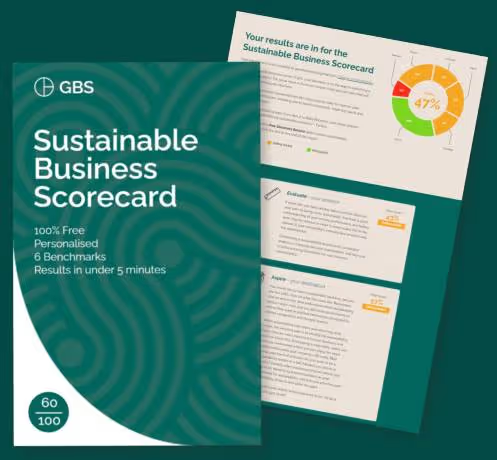
Discover your sustainability strengths and weaknesses with the Sustainable Business Scorecard.
Get My Sustainability ScoreGuide
Learn seven practical steps to put your sustainability plan into action, from activating owners and embedding change to measuring progress and maintaining momentum.
Article
The facts and fundamentals of climate change: what it is, when it will happen and what businesses can do about it.
Article
Your competitors can help you understand your sustainability performance. But the best organisations to compare with may not be the best ones to learn from.
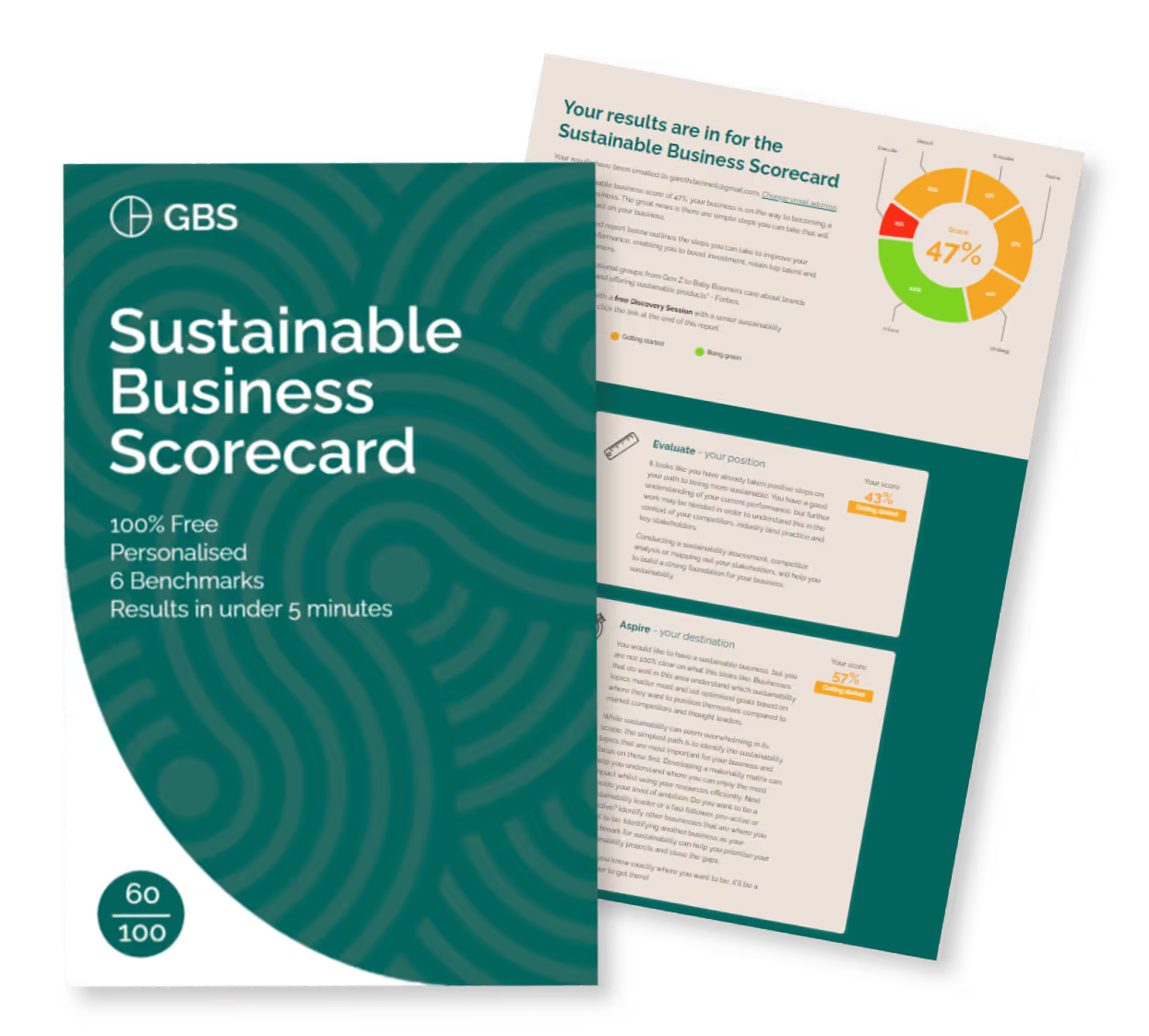
Our Sustainability Scorecard helps businesses quickly assess their current sustainability performance across key ESG topics.
In less than five minutes, you'll receive:

A sustainability rating
Practical recommendations
Identification of key strengths
A clearer sustainability roadmap
Areas for improvement

Instant results. No credit card required.


