Article
When businesses want to understand how well they’re performing on sustainability, they often start by looking at their competitors.
That’s usually a sensible place to start.
Competitors operate in the same market. They may use comparable materials, face the same regulations and respond to similar customer expectations. Comparing your performance with theirs can help you understand what is common in your sector, which areas you may be falling behind in and where you are already doing relatively well.
The problem comes when we ask that comparison to do another job.
The organisations that help you understand where you are now may not be the organisations that best help you decide where you want to go.
Businesses often use the word benchmark for several different purposes.
Two of the most important are:
comparing current performance with similar organisations;
using examples of stronger practice to help set goals.
These purposes are related, but they are not the same.
It helps to make the distinction explicit.
A Comparison Reference is often a group of similar organisations rather than one company.
You might compare your business with a group of competitors or peers that share your sector, business model, customers, geography, or operating constraints.
This can help you understand:
how your performance compares with similar businesses;
which sustainability practices are becoming common;
where important gaps remain; and
where you may already be performing strongly.
Comparison benchmarking provides context. It helps you evaluate where you are.
An Aspiration Reference has a different purpose.
It’s an organisation whose approach helps you see what stronger performance could look like in your own business.
It might be a competitor, but it doesn’t need to be. It could be a business from another sector that has found a particularly effective response to an issue that matters to you.
The main question is whether their experience can help you make a better decision.
Businesses similar to yours can help you understand what is normal in your sector. An organisation with a stronger approach may help you see what is possible.
I recently worked with a marketing business that wanted to become a recognised leader in sustainability.
The company already had particular strengths in diversity, equity and inclusion and in supporting social campaigns. It wanted those strengths to play an important part in its future sustainability strategy.
We began by benchmarking the business against a selected group of peers.
That comparison was useful across many topics. It helped the client identify areas where further work was needed, including some of its environmental policies beyond carbon emissions.
However, the same peer group became less useful when we looked at areas where the business was already ahead of its peers. In other cases, the peer organisations published too little information to provide a meaningful comparison.
So we asked a different question:
Which organisations make us think, “If in five years we were doing what they are doing, we would be really pleased with our progress”?
Those organisations were not necessarily businesses that did the same work as the client.
They were selected because they demonstrated the kind of sustainability performance the client wanted to work towards.
The original peer group helped us understand the client’s current position.
The additional organisations helped the client set its ambition.
That distinction became the first step in building its sustainability roadmap.
Imagine a sector in which sustainability performance is generally weak.
A business could compare itself with its competitors and find that it performs better on packaging, carbon management or responsible sourcing.
That conclusion may be accurate.
But being ahead of a weak peer group does not necessarily mean the business is doing enough to address the issue.
“Better than our competitors” and “good” are not always the same thing.
An Aspiration Reference helps the business look beyond relative performance and consider what meaningful progress might require.
The strongest example may come from outside the immediate peer group, particularly where another industry has already found a better response to a similar practical problem.
It can be helpful to identify an overall Reference Organisation for the business.
That organisation can provide a coherent example of the direction the business wants to take.
However, it may not offer the strongest example for every sustainability issue.
One competitor might be useful for comparing packaging practices, while another business may provide a stronger example of employee wellbeing, customer engagement or community impact.
A large organisation may demonstrate strong supplier standards while operating at a scale that makes parts of its approach difficult for an SME to apply.
For issues that are especially important to your business, or where you want to lead your industry, it may be useful to draw from best practice across different organisations and sectors.
The aim is to find examples that make your own decisions easier.
Sustainability benchmarking often relies on information that organisations choose or are required to publish.
Large and listed companies tend to produce more extensive sustainability information because they face greater reporting expectations and usually have more resources available.
Smaller businesses may publish much less.
In my own benchmarking work, I have found that information can be particularly limited in some sectors and on topics such as supply-chain requirements and health and safety.
SMEs with more mature sustainability approaches may also be easier to find because they have more activity, evidence and progress to communicate.
This means the businesses visible during public research may not represent the whole market.
This does not make benchmarking unusable. Far from it.
Benchmarking remains one of the most useful ways for an SME to understand its position, identify gaps and make better-informed decisions.
It simply means that publicly available information should be treated as useful evidence rather than assumed to provide a complete picture.
A useful benchmarking exercise does not need to be complicated.
Be clear about what you are trying to understand.
Are you assessing how your environmental policy compares with those of similar businesses? Are you trying to set an ambitious waste-reduction target? Are you looking for a better way to engage suppliers?
Different questions may require different references.
Select a group of organisations that are sufficiently similar to provide a meaningful comparison.
Look for patterns rather than allowing one unusual company to define the result.
This gives you a clearer view of how your current performance compares with your peers.
Consider whether your peer group provides a strong enough example of where you want to go.
Where it does not, look for an organisation with a more mature or effective approach to the issue.
That organisation may sit outside your sector.
An approach developed by another organisation will rarely transfer directly without adjustment.
Ask what they’re doing, why the approach appears to work, which parts are relevant to your business and what would need to change for your scale, customers, market or resources.
The comparison should help you identify gaps. The aspiration should help you decide what progress looks like.
Use both to shape your priorities, targets and roadmap.
Review your set of comparison businesses regularly, ideally at least once a year. A company that led on an issue three years ago may no longer provide the most useful example as markets, expectations and business practices develop.
Evaluate establishes your current position. Aspire defines where you want to go.
Peer benchmarking can support the first, while an Aspiration Reference can help with the second.
The two may overlap, but they don’t have to.
The easiest organisations to compare with yours may not be the most useful ones to learn from.
Before beginning your next sustainability benchmarking exercise, ask:
Are we trying to understand where we are, decide where we want to go, or both?
Once that is clear, it becomes much easier to choose the right benchmarks, and use them to make better decisions.
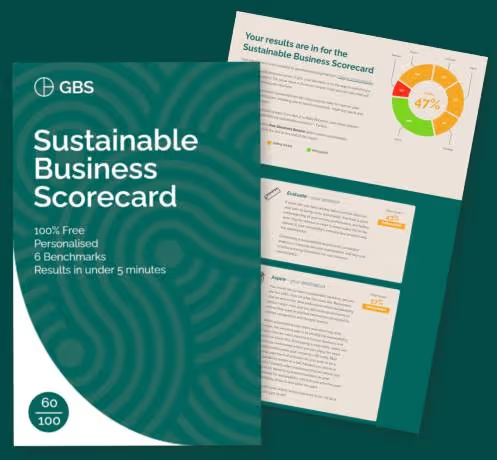
Discover your sustainability strengths and weaknesses with the Sustainable Business Scorecard.
Get My Sustainability ReportGuide
Learn what Net Zero means for SMEs, why it matters, and how to create a practical Net Zero roadmap. A simple guide for small businesses.
Tool
If you are a business that wants to set net zero emissions targets, check out these essential tools to help you get on the right path.
Guide
Sustainability consultancy provides a cost-effective option for small businesses, entrepreneurs and start-ups to quickly achieve their sustainability objectives.
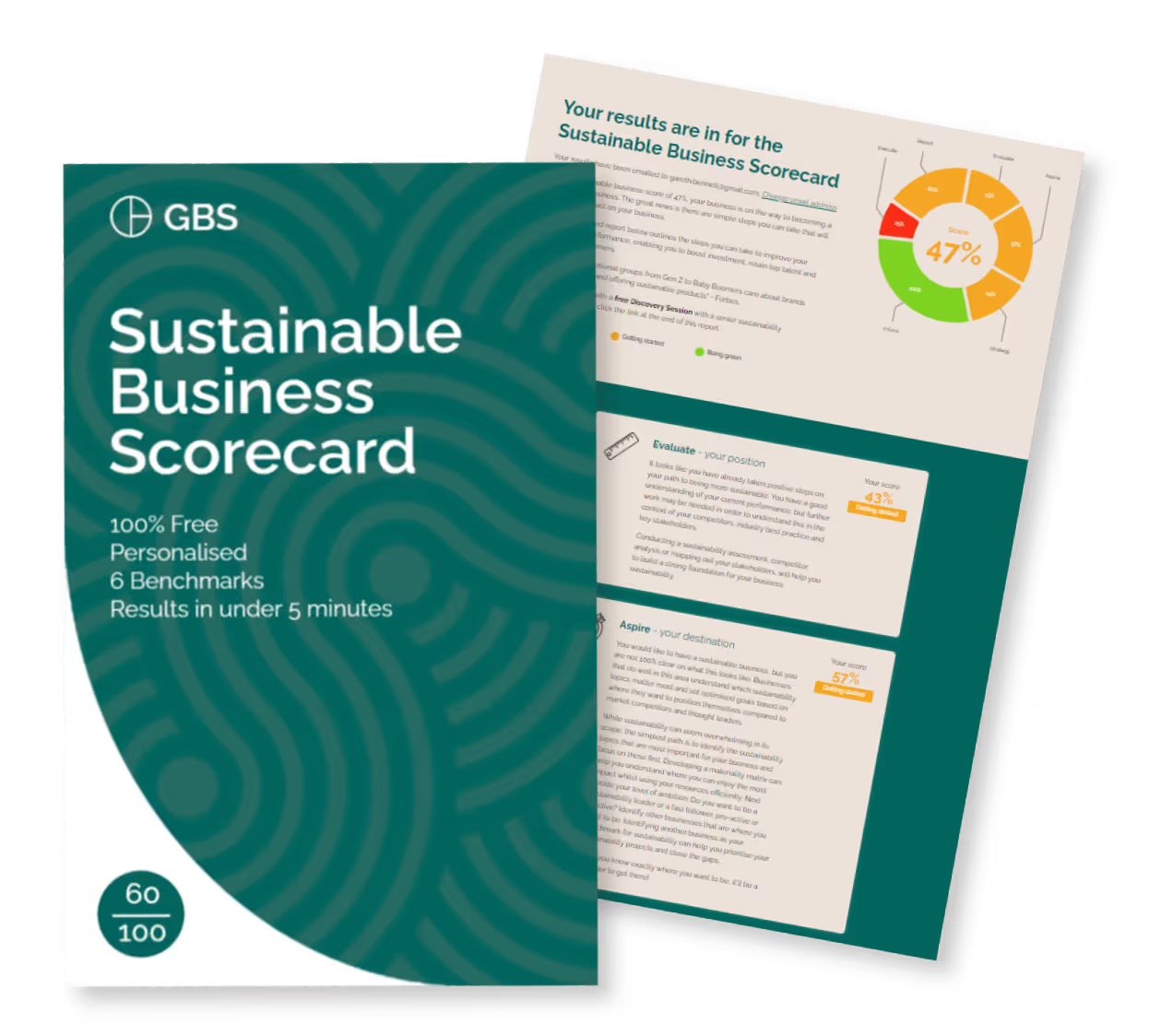
Our Sustainability Scorecard helps businesses quickly assess their current sustainability performance across key ESG topics.
In less than five minutes, you'll receive:

A sustainability rating
Practical recommendations
Identification of key strengths
A clearer sustainability roadmap
Areas for improvement

Instant results. No credit card required.


